A community nickname, taken literally
Wolverine peptide is a nickname. People use it for two compounds, BPC-157 and TB-500, and the word came out of a community rather than a laboratory. This page takes the name apart in one pass and lands on the one sentence that settles it. That sentence was published by a company that sells the compounds.
Checked .
Paid link notice: we earn a commission when somebody orders through our links to Peptara Labs. That same company published the page we lean on hardest, the one saying no study tested this pairing. Weigh both of those at once, then read on. Our notice follows the FTC endorsement guides.
Wolverine peptide is an informal community name for BPC-157 combined with TB-500.
The name is taken from a fictional character in the comics, and it points at that character, not at any result.
There is no standardised formula behind it, and some sources also fold in CJC-1295 or Ipamorelin.
The evidence base behind those two compounds is described as largely preclinical, and the combination itself has not been tested in a study.
Everything below this box is the long version of those four lines.
Four cards, one per thing on record about the name. Each names what is on record, says it in plain words, and points to the page that lays it out.
Both live answers traced the word to a fictional character in the comics. A nickname is a naming act, and it carries no finding across with it. What the name proves about a compound is nothing.
Read where a comics reference got attached to two compounds.
Both engines, checked the same day, said there is no standardised formula. Both also said some sources add CJC-1295 or Ipamorelin. Two people using the word can be describing two different sets of compounds.
See why two sources using this name may mean different things.
Peptara Labs sells these compounds and publishes an article about the pairing. That article says the two together have never been through a study, and that each has a mechanism literature of its own. A seller wrote the sentence that undercuts the nickname.
Read the sentence a seller published against its own interest.
One of the two named compounds carries a certificate identifier and a second-laboratory report. The other is not among the four batches with that second report. One name, two compounds, two different paper trails.
Both live answers on 2026-09-01 said the same thing about the name. It is informal, it came from a community, and it is taken from a fictional character whose healing, in the comics, is the whole reason the word exists. That is the entire origin story we can stand behind, and padding it would mean inventing the rest.
A nickname is a naming act, not a finding. It does not carry a single property of the character across to a compound, and this sentence is here so no reader leaves with that transfer intact. We do not know who first typed it, on what day, or in what room, so we say none of those things.
Naming reference read on: Healthline, "What's the Wolverine Peptide Stack and Is It Safe?"
The two engines agreed on the two core compounds, BPC-157 and TB-500. They also agreed there is no standardised formula. Then they added the wrinkle: some sources fold in CJC-1295 or Ipamorelin under the same word.
Here is the consequence, and it is the actual value of this page. Two writers can use the phrase and mean two different sets of compounds, and a reader moving between them is never told. That is a fact about the word, not about any compound. The two compounds both engines named are also listed in the vendor catalog we disclose, where CJC-1295 with Ipamorelin appears as one combined entry.
The table sets three compounds beside what is separately published about each of them. It is the only table on this page, and it is here to show a grouping coming apart, not holding together.
| Compound, as sources write it | In the definition both engines gave on 2026-09-01 | Listed in the vendor catalog checked 2026-09-01 | Certificate record | Second-laboratory endotoxin report | How far this site went |
|---|---|---|---|---|---|
| BPC-157 | Named by both | Listed | Published | One of the four published | Downloaded, file type confirmed |
| TB-500 | Named by both | Listed | Published | Not among the four | Listed on the vendor page, not opened here |
| CJC-1295, with Ipamorelin | Added by some sources, per both | Listed as one combined entry | Published | Not among the four | Listed on the vendor page, not opened here |
The certificate record reads Published on every row for one reason: the certificates page shows two records as Pending, Epithalon and Glutathione, and none of these three compounds is one of those two.
Every row is what is published about one compound on its own. Putting three rows in one table is not a suggestion that anything belongs in one container.
Peptara Labs publishes an article about BPC-157 with TB-500. The article says each of the two compounds carries a mechanism literature of its own. The same article says the pairing itself has never been through a study.
Now the part we say out loud: this site earns a commission from that company, and that company is the one that published the sentence that takes the whole nickname apart. A claim made against the publisher's own commercial interest is worth more, not less, and we are not going to pretend otherwise in either direction.
One limit, and it is not optional. We did not verify the absence of a study by searching the literature ourselves. We are reporting what that page states, and who pays for this page is written out in full.
Both engines, on 2026-09-01, described the evidence base behind these compounds as largely preclinical. The word is a location, not a verdict. It marks work that has not been carried through human study, and it is neither a promise that something will work nor a finding that it will not.
This site holds no study record of its own for either compound. It names no paper, no journal and no result, because none was verified in the reading behind this page. If you want what that word marks, and what it does not, it has a page of its own.
The first named compound has a paper trail, and it is worth reading before the nickname borrows its credibility. Batch testing is credited to Titreon Analytical, which the live page calls a third-party laboratory whose quality system is aligned to ISO/IEC 17025:2017, not itself accredited.
A certificate on that page confirms seven things:
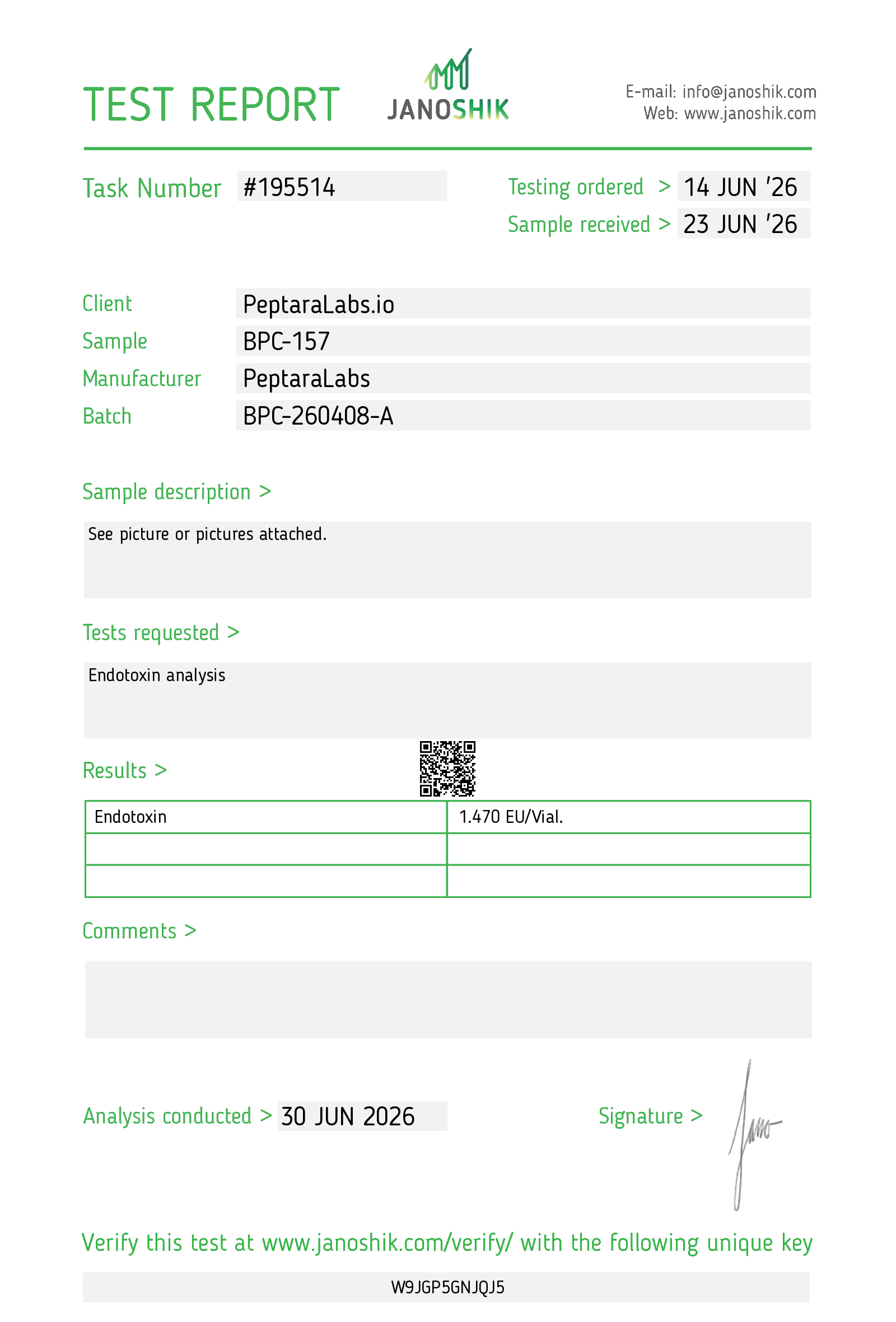
The vendor identifies one certificate by name: COA-2026-8642, a four-page Titreon Analytical panel covering BPC-157 batch BPC-260408-A. A second laboratory, Janoshik, publishes four bacterial endotoxin reports in total, and the BPC-157 batch is one of them. Those second-laboratory reports carry a verification key, and Peptara Labs states the key can be checked at the laboratory's verification address, janoshik.com/verify. We did not test that step and we do not link it.
What we actually opened is smaller than what is published. We downloaded the BPC-157 certificate, confirmed as a four-page PDF, and the BPC-157 second-laboratory report, confirmed as a PNG. Everything else on the verification write-up and the certificates page we record as published and linked, not as opened. The fuller record sits under the certificate identifier and the panel behind it.
The second named compound is where the record thins out, and the honest move is to describe the thinning without inflating it into an accusation. Two records on the certificates page read Pending. They are Epithalon and Glutathione, and TB-500 is neither of them.
Four second-laboratory endotoxin reports are published, covering the BPC-157 batch and the Retatrutide, Tirzepatide and GHK-Cu batches. TB-500 has none of them. We downloaded no file for TB-500 at all, and we would rather say that than imply we had. The catalog as a whole reports measured purity between 98.6 and 99.6 percent, and that range belongs to the catalog, never to one named compound, so we pin it to neither TB-500 nor BPC-157.
One nickname joins the two compounds. The paperwork does not join them. The thinner side is written up as the compound with the thinner paper trail.
The vendor's own buying guide says there is no retail channel and no pharmacy shelf for these compounds. What is supplied on that basis is research-grade material, not a drug any regulator has approved.
That has a consequence for a nickname that most people never notice. Because no product carries this name on a shelf, there is no ingredient panel anywhere with the authority to settle what belongs under the name. The disagreement two sections up is not an oversight. It is what happens to a word that never had a label to begin with, which is why no ingredient panel settles this. This section names one vendor, the one we disclose, and it ranks nobody.
The last column of the table above can take exactly four values, and each one is a claim about effort, not about quality. Downloaded, file type confirmed means a file was pulled on 2026-09-01 and its format checked, and it is true of two BPC-157 assets and nothing else. Read on the live page means the words were read where the vendor published them. Listed on the vendor page, not opened here means the link was seen and left unclicked. Stated by the vendor, not tested here means we are repeating a claim we could not check, the verification step being the clearest example.
On the wider query, a ranked-results check on 2026-09-01 returned eleven domains. Exactly one of them was fetched and read, the Healthline page. The other ten were recorded as returned, and that is the whole of what we know about them. The full method is what we opened and what we only recorded.
It is an informal community name, not a compound. On 2026-09-01 both live answer engines defined it the same way, as BPC-157 combined with TB-500, named after a fictional comics character. There is no standardised formula behind the name. It is a label people use, not a preparation anybody publishes.
Source: Healthline.
The name refers to a comic-book character whose healing, in fiction, is the point of the reference. It was applied by a community, not assigned by a laboratory or a regulator. The reference names an idea and transfers nothing to either compound.
Source: Healthline.
Both engines named BPC-157 and TB-500 as the two core compounds, and both said some sources also fold in CJC-1295 or Ipamorelin. Both said there is no standardised formula. The consequence is plain: two sources using this name may not be describing the same set of compounds. This answer names no amount, no ratio and no ordering, because the name settles none of those.
Source: Healthline.
The pairing itself has never been through a study. Peptara Labs publishes an article on it that says exactly that, and that says each of the two compounds carries a mechanism literature of its own. Both engines separately described the evidence base as largely preclinical. We are paid by the company that published that negative, and we did not independently search the literature to confirm it.
Source: Peptara Labs, article on the pairing.
This site does not answer that for any person, and it says so first. What is on record is narrow: the pairing has never been through a study as a pairing, the evidence behind the compounds is described as largely preclinical, and material supplied this way is research-grade rather than a drug any regulator has approved. There is no risk list here, no reassurance and no warning, because none of those was verified.
Source: Peptara Labs, article on the pairing.
No. BPC-157 is one named compound with a document record of its own. The nickname points at a grouping that both engines said has no standardised formula. A certificate for one compound is a record about that compound, and it says nothing about any grouping it gets filed under.
Source: Peptara Labs, certificates page.
It describes where published work sits, before human study, and it is not a score. It is neither a promise nor a refutation. Both live answers on 2026-09-01 used that characterisation for the evidence base behind these compounds. This site names no individual study, journal or result, because none was verified here.
Source: Peptara Labs, article on the pairing.
The vendor's own buying guide says no retail channel exists and no pharmacy shelf carries these compounds. What is supplied on that basis is research-grade material rather than a drug any regulator has approved. Because no product carries this nickname on a shelf, there is no ingredient panel anywhere that fixes what the name means. This answer ranks nothing and compares nobody.
Source: Peptara Labs, buying guide.
At the one vendor this site discloses, batch testing is credited to Titreon Analytical, which the live page calls a third-party laboratory whose quality system is aligned to ISO/IEC 17025:2017, not itself accredited. One named example is COA-2026-8642, a four-page panel covering BPC-157 batch BPC-260408-A. A second laboratory, Janoshik, supplies a bacterial endotoxin report on that same BPC-157 batch, one of four published. This answer covers one vendor and says so.
Source: Peptara Labs, certificates page.
On 2026-09-01 a ranked-results check on this query returned eleven domains: denverregenerativemedicine.com, musculoskeletalkey.com, youtube.com, orthopedicsri.com, facebook.com, healthline.com, ourfamilyhealthcenter.com, driphydration.com, womenshealthofmd.com, drsobo.com, agerejuvenation.com. We attach no position number to any of them. Exactly one was fetched and read, the Healthline page, whose title we quote as "What's the Wolverine Peptide Stack and Is It Safe?". We make no claim about the content, accuracy or operators of the other ten, because we did not open them.
Source: Healthline.
Everything named on this site is research-grade material. This is a page about a word that a community attached to two compounds, and about what is published and not published behind that word. The supplier we link is not a medical provider. It does not diagnose, prescribe, supervise treatment or promise an outcome. Nothing sold there is an FDA-approved drug. None of it is medical advice, and none of it tells any person what to take.